
Decatur County Criminal Court Cases
Decatur County sits in Iowa’s Fifth Judicial District. The Iowa District Court is the unified trial court, so there is no separate modern Leon, Lamoni, or Grand River criminal-court database to search. District judges have general felony jurisdiction. District associate judges hear indictable misdemeanors and other assigned matters, while magistrates handle simple misdemeanors, traffic matters, and ordinance cases.
The Clerk of Court keeps the local Decatur County criminal case file at 207 N. Main Street in Leon. The counter is open Monday through Friday from 8:00 a.m. to 4:30 p.m., and its current phone number is 641-219-4265. Judge’s chambers has a different number and is not the routine records counter. The clerk is the right office for docket documents, older case files, and questions about public access.
Decatur County’s Wednesday Magistrate
An official Iowa Judicial Branch order designates Wednesday from 9:00 a.m. to 4:30 p.m. for Decatur magistrate availability, except holidays and approved exceptions. That local schedule helps explain when simple misdemeanor, traffic, and ordinance work may be heard. It does not narrow the clerk’s regular weekday record-counter hours.
The distinction matters. A reader seeking a court file should contact the clerk during the clerk’s published hours, not wait for the magistrate window. Court staff can identify the public access route, but they cannot provide legal advice about a charge or deadline.
Searching Decatur County Case Records
The main remote channel is Iowa Courts Online, the Judicial Branch’s statewide Electronic Docket Record Search. It is a free case index, not the account-required EDMS/eFile system and not a promise of free access to every filed document. Use this sequence to search Decatur County criminal court cases and confirm the result.
- Open Trial Court Statewide Name Search and enter at least two letters in Last/Firm Name.
- Add a first name when known. Use the percent sign wildcard for uncertain spelling.
- Open the blue Case ID and confirm Decatur County, the party, and the case type.
- Read each charge, filing event, and disposition separately rather than relying on the case caption.
- Ask the Decatur County clerk for a public document, terminal access, or an older file that is not available remotely.
The official Iowa Courts Online help guide documents the public search controls shown below.
| Field Label | Type | Required | Options or Notes |
|---|---|---|---|
| Last/Firm Name | Text | Yes | At least two letters; percent wildcard allowed |
| First Name | Text | No | Enter a first initial with no period |
| Second Party Name | Text | No | Adds a second person or firm |
| AND / OR | Selector | Conditional | AND requires both names; OR accepts either |
| Case ID | Result link | N/A | Blue link opens trial detail |
Common names require a second check. Compare the caption, county, case type, and any available party details before opening the docket. The public name search can return civil and other matters along with criminal cases, so a matching name alone does not establish that the result is a Decatur County criminal prosecution. If two parties are known, AND narrows the search to matters containing both. OR broadens it to either party.
Decatur County Criminal Docket Access
Iowa Courts Online has several access layers. Bracketed links are free, while non-bracketed detail links may require a subscription or a public terminal at the filing county’s courthouse. Schedule search, advanced trial search, bonds, service returns, exhibit lists, and some indexes may sit in a subscriber or terminal layer. A visible docket entry therefore does not mean its underlying PDF can be opened from home.
The official portal view assigned to Decatur County can be seen at the statewide docket interface.
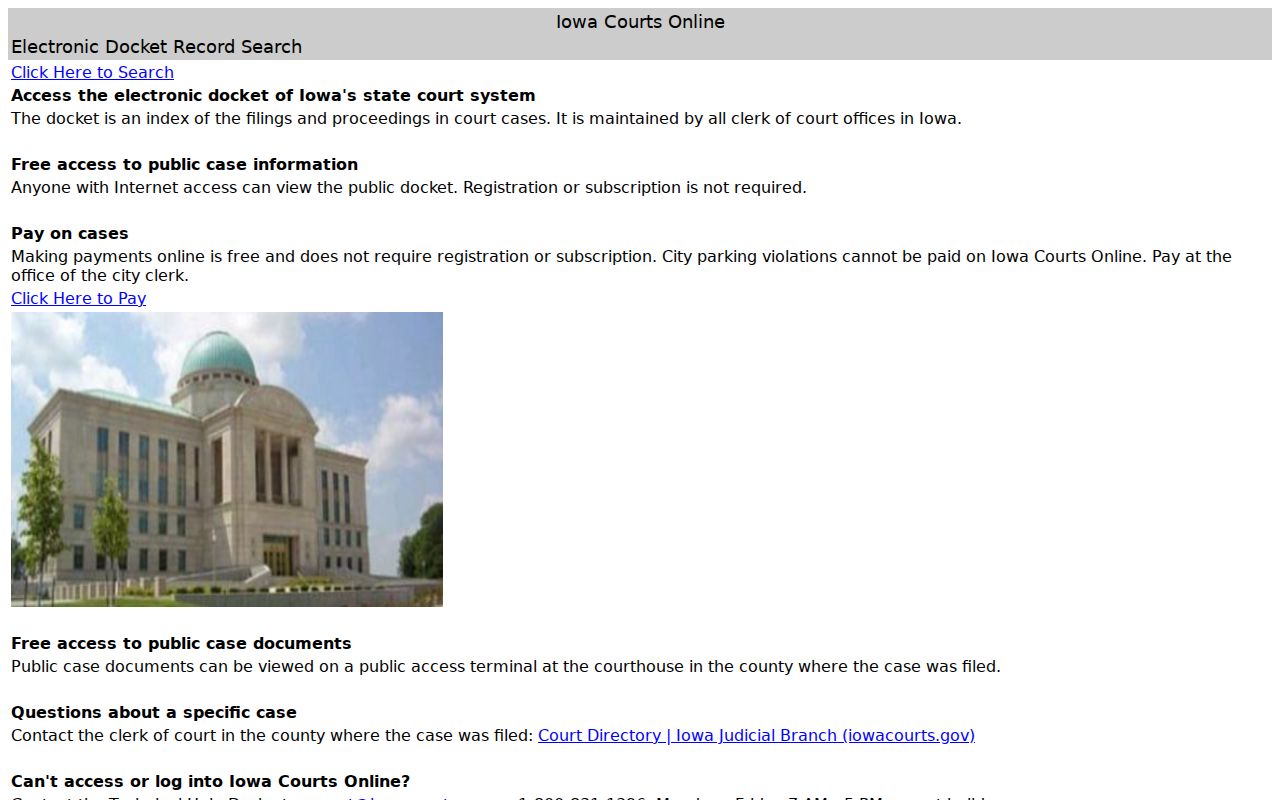
The interface is the starting index; the Decatur County clerk counter remains the document-access fallback when a link is restricted or incomplete.
Note: Public cases generally appear one business day after creation, while entered docket data then updates in real time.
Inside a Decatur County Case File
A court file is arranged around a Case ID and a sequence of judicial events. It is not a police narrative, booking gallery, or statewide rap sheet. The Decatur County criminal case record can show how allegations changed after review by the county attorney and how the court resolved each count.
| Case ID and Title | Identifies the Iowa trial case, caption, court, and parties. |
|---|---|
| Charges | Lists filed criminal counts, which may differ from booking allegations. |
| Docket Events | Tracks filings, hearings, orders, pleas, and other dated activity. |
| Lawyers | Names counsel recorded for the parties when publicly available. |
| Disposition | Shows the result for each count, such as dismissal, acquittal, deferred judgment, or conviction. |
| Financials | Separates amounts owed, fines, fees, restitution, and recorded payments. |
| Added Terminal Detail | May include schedules, bonds, service returns, exhibit lists, or judgment indexes. |
Juvenile and other confidential cases are excluded from public views. A docket also does not promise a booking image, the full incident report, or every repository entry.
Older Decatur County Court Records
Pre-1998 Decatur County case records may be paper files or only partly indexed. When a name search fails, call the clerk and provide the party name, approximate year, known charge, and any case number. The local counter can explain whether a public file may be reviewed there and whether a specific document exists.
Decatur County’s courthouse history gives this archive unusual context. County records were reportedly moved by ox wagon during the disputed 1853 county-seat change. Wind destroyed an unfinished courthouse, and another courthouse burned in 1874. Voters later approved the present building, which was dedicated in 1908 as a fireproof repository.
The county’s courthouse history preserves that account and supplies the image below.
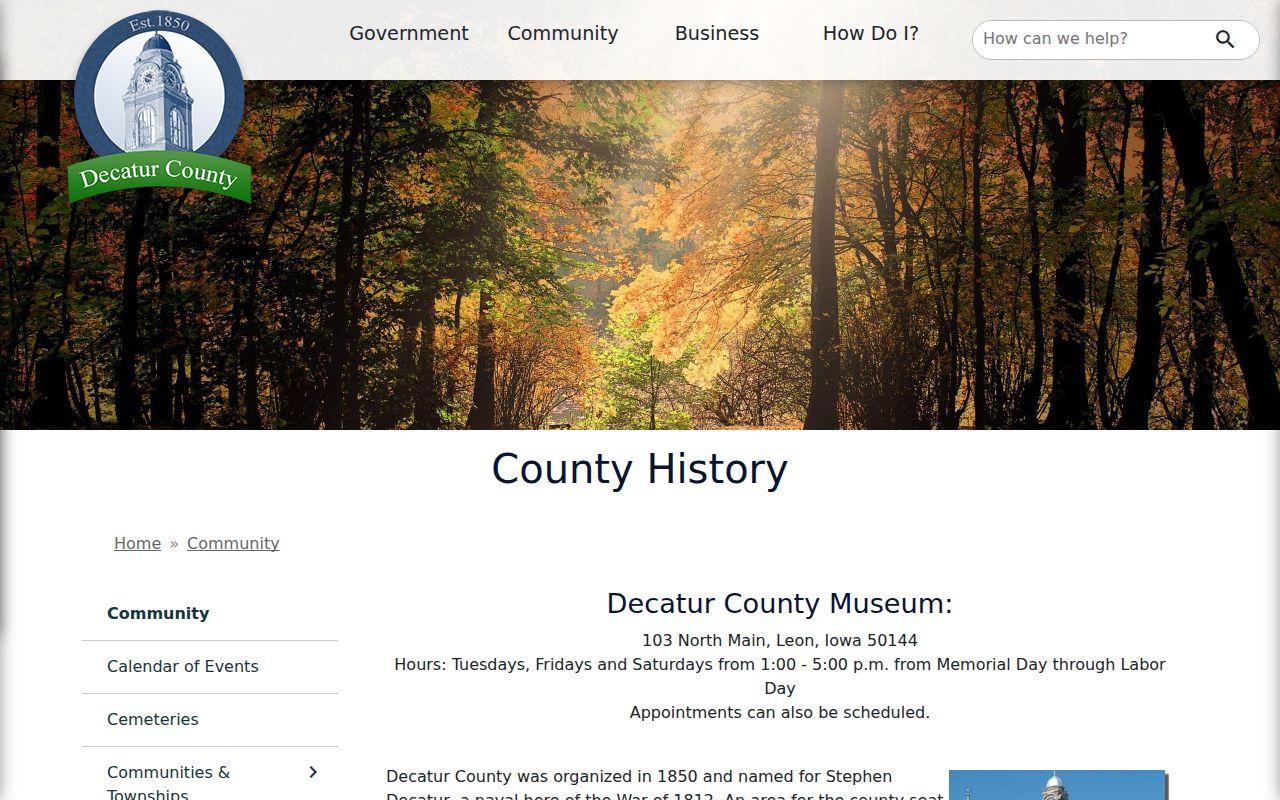
The building’s role is practical today: it holds the clerk counter and the public terminal used when remote docket access stops short.
How a Criminal Case Moves
A Decatur County criminal case begins in court only after a complaint or other charging step creates a judicial file. An arrest can happen first, but a booking allegation is not automatically the filed count. The county attorney may file a trial information, or a grand-jury process may apply. The accused then proceeds through arraignment, pretrial work, and a plea or trial.
Case flow: Charges Filed › Arraignment › Pretrial › Plea or Trial › Disposition › Sentencing
Read the chronology count by count. One count may be dismissed while another ends in conviction. A later appeal adds a new layer but does not erase the trial docket. Readers tracing the event before filing can use the county’s arrest lookup routes for the separate agency and booking records.
Reading Decatur County Case Outcomes
Disposition terms answer different questions. “Dismissed” means prosecution of that count ended without a judgment of guilt, although related counts or cases may remain. “Acquitted” or “not guilty” is an adjudicated non-conviction. “Pending” means the docket does not yet show a final result. “Convicted” means the court entered a judgment of guilt.
- Deferred judgment
- Judgment is withheld while conditions are completed. Successful discharge is a non-conviction, but DCI release rules still matter.
- Trial information
- The prosecutor’s formal Iowa charging document.
- Arraignment
- The stage at which a plea is entered to the filed charge.
- Expunged or confidential
- Public access is restricted under legal authority; it does not promise universal physical destruction.
Case debt must also be read apart from guilt. Fines, surcharges, costs, restitution, and payments are separate fields. A June 2026 Decatur County meeting record documents an agreement with Warren County for collection of court-imposed obligations. That later collection activity does not change the underlying disposition.
A disposed Decatur County case can still show money due or later collection events. That activity does not reopen the question of guilt. Match each payment or balance entry to the judgment and sentence, and ask the clerk when a financial label is unclear. A docket may record the amount owed without exposing every supporting filing from home.
Current Decatur County Clerk Contacts
The clerk’s telephone and fax numbers changed on March 4, 2025. The official county change notice explains why older directories can send a Decatur County court-record request to a stale number. Use the current county page and identify the case, document, and desired format before asking about copy or certification costs. No local copy or certification fee was verified in the research, so the clerk should quote it.
Decatur County Clerk of Court
207 N. Main Street
Leon, IA 50144
641-219-4265
Monday-Friday, 8:00 a.m.-4:30 p.m.
Fax: 641-222-1913
The clerk counter handles routine Decatur County criminal case access. Judge’s chambers, at 641-219-4271, is a distinct contact and should not receive ordinary record requests.
Case Record Access & Restrictions
Iowa’s court dockets are broadly open, but public access has firm limits. Juvenile cases, expunged or confidential matters, victim and minor identifiers, medical details, and protected personal data may be omitted or redacted. The Iowa Open Records Law does not override a separate confidentiality statute. Iowa Code chapter 602 supplies the unified court and judicial-officer framework, while chapter 902 and chapter 903 govern felony and misdemeanor sentencing ranges.
Iowa Code chapter 692 governs criminal-history dissemination, while chapter 901C controls qualifying expungement. Those repository rules do not turn a court docket into a complete DCI history. A missing result may reflect spelling, timing, old paper files, confidentiality, or use of the wrong custodian. Confirm the exact party and Decatur County before drawing a conclusion.
When a Decatur County case should exist but does not appear, try a shorter name with the official wildcard, check whether one business day has passed since case creation, and confirm that the matter was filed in Decatur rather than another county. Then call the clerk about older paper records or restricted access. A police report can exist even when the prosecutor never opened a court case.
Access point: Search the free docket first. Use the filing county’s public terminal or clerk when the index names a document but does not expose it online.